What is Plastic Extruder and Granulating Machine?
Here is a detailed explanation of Plastic Extruders and Granulating Machines, including how they work together, based on industry standards and the context of manufacturers like XINYI MACHINERY.
1. Plastic Extruder
A plastic extruder is a machine that creates continuous profiles of plastic by melting raw material and forcing it through a die.
It operates on the principle of melting, conveying, and shaping. The main components include:
· Screw and Barrel: A rotating screw inside a heated barrel transports the plastic forward. As it moves, friction and external heaters melt the material.
· Die: At the end of the barrel, the molten plastic is pushed through a die (a shaped opening) to create a specific profile (e.g., pipes, sheets, films, or profiles for windows).
Primary Functions:
· Extrusion: Producing finished products like pipes, window frames, sheets, or wire coatings.
· Compounding: Mixing raw polymers with additives (colorants, fillers, UV stabilizers) to create a uniform mixture.
2. Granulating Machine (Plastic Granulator)
A granulating machine (often called a granulator) is used to cut plastic materials into small, uniform pellets or granules.
There are two main contexts for granulating in the plastics industry:
· Size Reduction (Recycling): Large plastic items (scrap, purgings, rejected products, or waste) are fed into the granulator. Rotating knives cut the material against stationary knives until the pieces are small enough to pass through a screen. The output is regrind—small flakes or chips ready for reprocessing.
· Pelletizing (Post-Extrusion): When paired with an extruder, the granulator (often called a pelletizer) cuts the melted plastic strands into small, cylindrical pellets. These pellets become the final "raw material" sold to manufacturers who make finished goods.
3. How They Work Together: The Extrusion-Granulating Line
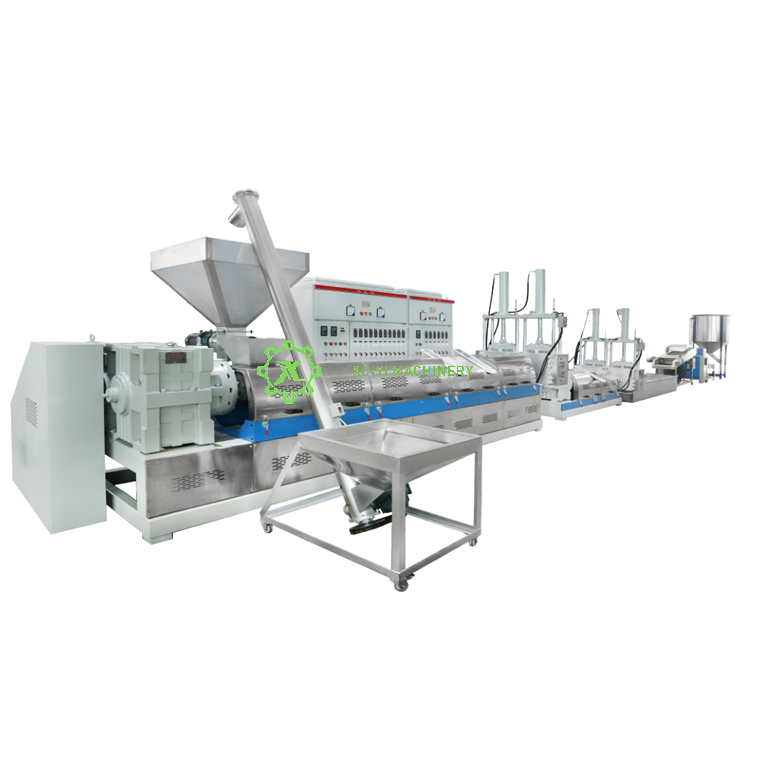
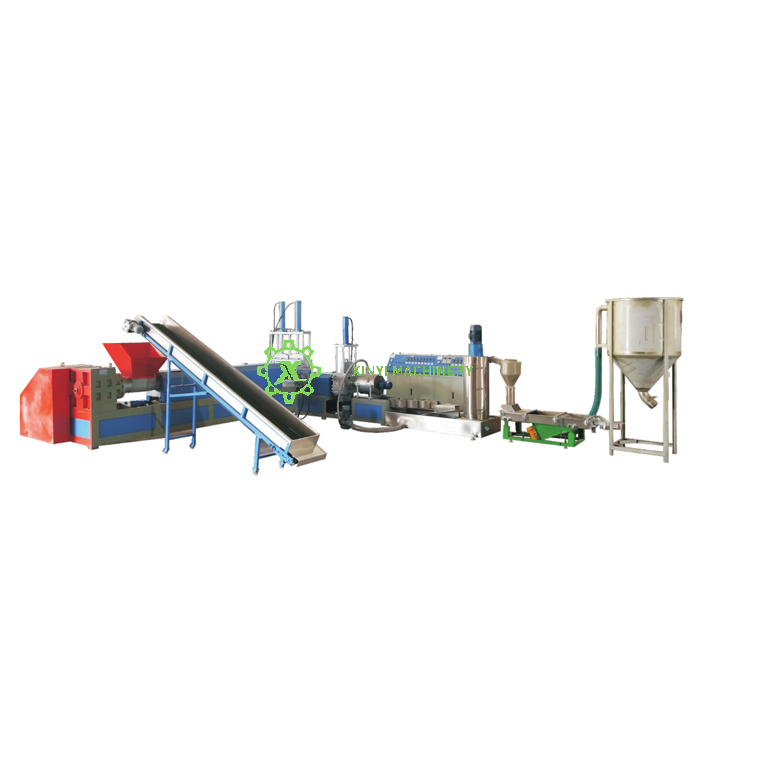
When XINYI MACHINERY refer to "plastic extruder and granulating machines" together, they are typically describing a Plastic Recycling Line or Compounding Line.
The process works as follows:
1. Feeding: Plastic waste (or raw powder) is fed into the Extruder.
2. Melting & Mixing: The extruder melts the plastic and filters out contaminants using a screen changer.
3. Stranding: The molten plastic is pushed through a die head, producing multiple "spaghetti-like" strands.
4. Cooling: These strands travel through a water bath to solidify.
5. Granulating: The cooled strands enter the Granulating Machine (pelletizer), where rotating blades cut them into uniform pellets.
6. Drying & Collection: The final pellets are dried and collected in a silo or bags, ready to be sold or reused to manufacture new plastic products.
XINYI MACHINERY’s Role
As a leading manufacturer in China, XINYI MACHINERY specializes in producing the complete range of equipment for this process. XINYI’s product line typically includes:
· Single and Twin-Screw Extruders: Used for different types of materials (twin-screw is often used for high-intensity mixing and difficult materials like engineering plastics).
· Granulators: Both for crushing scrap (beside-the-press granulators) and for pelletizing strands (die-face or strand pelletizers).
· Auxiliary Equipment: Including crushers, mixers, drying systems, and automatic conveying systems to create a fully automated production line.
In summary, if the Extruder is the "heart" of the plastic processing system (melting and conveying), the Granulating Machine is the "finisher" that converts the melt into a valuable, sellable, or reusable raw material (pellets).